
The Map I Drew on the Way Out
Why I wrote The Pattern Was Never Love

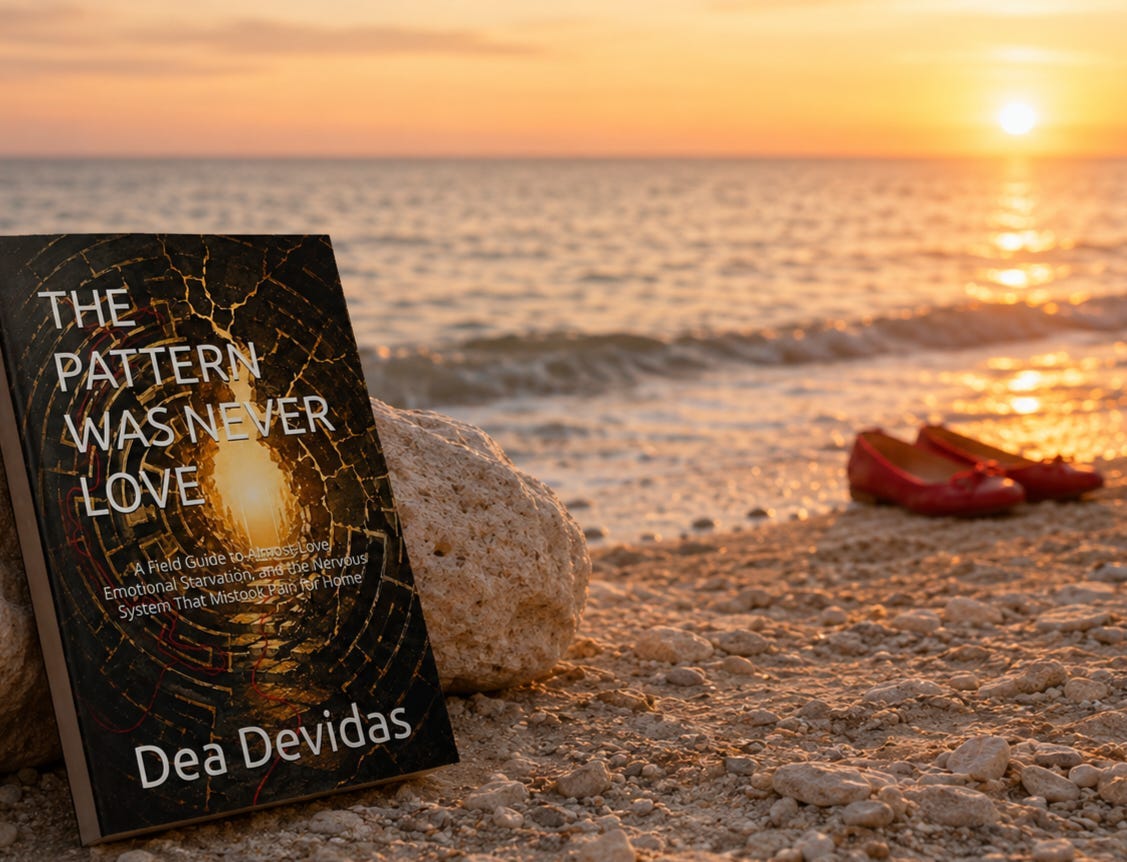
I spent years inside a labyrinth that looked like a relationship. Nice furniture. Good lighting in certain corners. Just enough tenderness to make you think you were almost at the center of something beautiful, when actually you were three corridors deep into a loop that always brought you back to the same wall.
I didn’t know it was a labyrinth while I was in it. Nobody does. That’s the design.
My body knew before I did. My bones were drawing the map while my mind was still calling it home. My blood was keeping records while my heart was still filing the evidence under “love.”
When I finally walked out... and it wasn’t dramatic, it wasn’t cinematic, it was more like a Tuesday where I simply stopped turning left at the wall I’d been turning left at for years... I realized something strange. I had memorized every corridor. Every dead end. Every door that was actually a wall. Every “maybe this time” passage that loops you right back to start while you swear you’re making progress.
I could have been embarrassed that I walked that maze for so long. There was a moment where I almost was. My shame pulled up a chair, ordered an espresso, and started composing a very convincing TED Talk called “Why You Should Never Tell Anyone About This.”
(My shame, pitching the cover-up: “Okay so what if we just... don’t? What if we pretend we learned this wisdom from a book, a retreat, maybe a very expensive therapist in Zurich? Nobody needs to know we learned it by walking face-first into the same glass door for three years. We have a REPUTATION.” My bones: “Sit down. We’re drawing the map.”)
Something fiercer than shame rose in my chest. Not anger. Not revenge. Just... clarity. The kind that lives in your pulse after you’ve been holding your breath for years and you finally, quietly, exhale. The kind that doesn’t need to shout because it already knows.
I wrote this book in that exhale.
Not from the wound. From the other side of it.
I wrote it because somewhere right now, a woman is Googling “why can’t I leave” at 2am. And she’s going to find listicles. She’s going to find “10 Signs You’re in a Trauma Bond” articles written by people who studied it in textbooks. And those are fine. But they won’t make her feel SEEN. They won’t describe the exact moment when your nervous system has been running contradiction as a lifestyle for so long that peace feels like a threat. They won’t map the specific way your amygdala starts treating crumbs as feasts because the baseline dropped so low that “he texted back” became the whole meal.
This book does.
I gave my nervous system a microphone. I let my cells take the stand. I let my body testify in the language it always spoke but nobody was translating: the flinch before his key hit the lock, the stomach drop when his tone shifted, the way your skin learns to predict weather systems inside another person’s mood before you even know you’re doing it.
Every chapter is a corridor I walked. Intermittent cruelty. The knife that never softens. The hologram he loved instead of you. The inner judge he installed so quietly you thought it was your own voice. The starvation bridge. The chase fantasy. The closure trap.
I mapped them because I know them. Not from research. From my feet on that ground. From my pulse in those walls.
(Each chapter is basically my amygdala finally getting a microphone after years of being told “you’re overreacting” and delivering a 130-page testimony with citations, humor, and absolutely zero chill. My prefrontal cortex tried to edit for tone. My amygdala said “you had your turn for three years and look where that got us.” Fair point.)
I’m not angry anymore. That’s the part that surprises me. I thought writing this book would be an act of rage. Instead, it was an act of breathing. Every page I wrote, my chest opened a little more. Every pattern I named lost a little of its power. Every corridor I drew on the map became a corridor I no longer had to walk.
The labyrinth doesn’t disappear when you leave it. But it shrinks. It becomes something you can hold in your hand and look at and say: I see you. I see every turn. And I’m not inside you anymore.
I wrote this book for the woman still inside.
Not to rescue her. She doesn’t need rescuing. She needs what I needed: someone who’s been in the exact same room saying “the door is here. I know it doesn’t look like a door. I know it looks like another wall. But I promise you... it’s a door. I used it. It works. You can too.”
My hand is reaching back into the labyrinth. Not with urgency. Not with pity. With the calm of a woman who finally breathes and wants you to breathe too.
The pattern was never love. But you are. And this book is the map I drew on the way out, left at the entrance, for you.
🔥💎