
Intermittent Cruelty: The Slot Machine of Almost-Love
Why "sometimes kind" is neurologically worse than "always cruel", and why your body gets addicted to the maybe


You’ve been feeding quarters into a man for three years and calling it a relationship. Pull the lever, lose. Pull the lever, lose. Pull the lever, he brings flowers and asks about your day, and suddenly you’re convinced THIS is who he really is, the other fourteen losses were just bad luck, and now you’re $46,000 in emotional debt and the casino doesn’t do refunds. Just complimentary trauma bonds and a loyalty card that gets you 10% off your next heartbreak.
Your blood already knows what your mind refuses to calculate: the math has never worked. The house always wins. And your cells have been holding their breath between jackpots, mistaking relief for love, mistaking the absence of cruelty for the presence of care. Your bones have been counting cards in a game that was rigged before you sat down.
Here’s what B.F. Skinner figured out while torturing rats in the 1950s, and what your nervous system figured out while tolerating someone who was only kind on Tuesdays: variable ratio reinforcement creates the strongest behavioral addiction of any reward schedule. Stronger than consistent rewards. Stronger than consistent punishment. The unpredictability is the hook.
(Science translation for those of us who didn’t voluntarily read psychology textbooks: Your brain releases more dopamine for MAYBE than for YES. The anticipation of possible reward lights up your neural pathways like a Christmas tree having a seizure. This is why you check your phone forty-six times after sending a text. This is why casinos make more money than God. This is why you keep hoping he’ll be the soft version today even though statistically, historically, cellularly, you know better.)
Your skin was trained on inconsistency before you had language for it. Your pulse learned early: love comes with a schedule, and the schedule is not posted. Your womb understood at seven what your prefrontal cortex is still arguing about at thirty-seven: that the most dangerous people aren’t the ones who are always cruel. They’re the ones who are sometimes kind.
The Neuroscience of Almost
Let me tell you about dopamine, baby. Not the simplified Instagram infographic version. The real shit.
Your brain doesn’t actually spike dopamine when you GET the reward. It spikes during the ANTICIPATION of maybe getting it. The uncertainty is the drug. The not-knowing is the hit. Your neurons are basically running a predictions market, and every time the outcome is uncertain, they flood your system with the good chemicals. (Your amygdala, watching you check if he’s in a good mood: “Ooh, today’s a mystery! Will we get the version who remembers our birthday or the version who forgets we exist? Let’s flood the system with anticipation chemicals! This is FUN! We love gambling with our emotional wellbeing! The dopamine economy is THRIVING!”)
Your blood has been chasing a high that only exists in the space between cruelty and kindness. Your cells learned to live in the gap, to thrive in the uncertainty, to call the chaos “passion” and the relief “love.” Your bones now hold the shape of waiting… always waiting… for the next spin of the wheel.
Consistent cruelty is actually easier to leave. Your nervous system goes: “This is bad. This is always bad. We should go.” Clean signal. Clear message. Exit strategy activated. But intermittent cruelty? Your nervous system goes: “This is bad BUT REMEMBER THAT ONE TUESDAY? And what about when his mom was sick and he actually cried? And that time he made dinner? WHAT IF THE GOOD VERSION IS THE REAL ONE AND WE JUST NEED TO BE PATIENT?” Spoiler alert: the good version is not the real one. The pattern is the real one. The kindness is the slot machine paying out just enough to keep you playing.
The Chemistry You Thought Was Love
Here’s what nobody tells you about that electric feeling you had with him. What your brain calls “chemistry” is actually reward prediction error wearing perfume.
When you expect coldness and receive a crumb of softness, the contrast hits your dopamine system like a jackpot. Not because the love is bigger, but because the nervous system is starving. A crumb feels holy when you’ve been emotionally fasting for years. (Your dopamine neurons, doing math you didn’t authorize: “Okay so baseline expectation was: he ignores us. Actual outcome: he asked how our day was. THAT’S A 46% POSITIVE DEVIATION FROM PREDICTED REWARD. RELEASE THE CHEMICALS. THIS IS LOVE. No wait, this is statistics. Same thing apparently. God, we need better criteria.”)
Your skin registered danger and then received unexpected gentleness, and that GAP… that distance between expectation and reality… became the drug. Your pulse didn’t fall in love with him. Your pulse fell in love with the contrast. Your womb didn’t open to his presence. It opened to the relief of his absence-of-cruelty, which felt like presence because you’d forgotten what presence actually tastes like. This is why the “nice guy” feels boring. This is why stability reads as suspicious. This is why someone actually showing up consistently makes you feel nothing while someone showing up unpredictably makes you feel EVERYTHING. Your chemistry is lying. Your chemistry is a starving system calling crumbs a feast.
The Quantum Mechanics of Maybe
Here’s where it gets properly weird. In quantum physics, there’s something called superposition: a particle exists in multiple states simultaneously until it’s observed. Schrödinger’s cat is both alive and dead until you open the box. You’ve been dating Schrödinger’s boyfriend. He’s both cruel and kind until you observe him. Every interaction is a new measurement. Every morning you wake up not knowing which version you’re going to get.
Your skin has been existing in superposition: both loved and unloved at the same time. Your pulse has been entangled with someone’s potential rather than their pattern. Your womb has been holding space for a man who collapses into cruelty every time you actually look.
(Your inner physicist, trying to explain your relationship to your therapist: “So basically he exists in a wave function of possible emotional states, and my observation keeps collapsing him into the asshole configuration, and I’m starting to think the probability distribution was never actually 50/50, it was more like 90% dick and 10% that one time at IKEA when he held my hand in the lighting section and I decided that meant we had a future.”)
The observer effect says that the act of measurement changes the outcome. And maybe that’s what you’ve been hoping: that if you observe him CORRECTLY, if you approach from the RIGHT angle, if you measure with enough love and patience and perfectly-timed lingerie, he’ll collapse into the kind version permanently. But here’s what quantum physics also teaches: some particles are simply more likely to be in certain states than others. The probability is built into the system. You’re not measuring wrong. He’s just probably an asshole.
Fantasy doesn’t survive repeated contact with behavior. One kind day can shimmer in superposition: maybe he’s changing, maybe this is real, maybe the pattern is breaking. But three years of data? That’s measurement. The wave function collapses. What’s left is just... the pattern. The accountant has arrived and the books don’t lie.
(A note for the physicists in the room: No, this is not literal quantum mechanics applied to men with the emotional range of a wet sock. This is metaphor. But here’s the thing about metaphors: they work because they’re TRUE in the places that matter. Your hope kept treating potential as reality. The pattern kept collapsing into data. The math checks out even if Schrödinger would object to the methodology.)
The Slot Machine Architecture
Let’s talk about how casinos actually work, because your relationship has been designed by the same engineers.
Casinos don’t want you to lose every time. If you lost every time, you’d leave. They want you to win JUST ENOUGH to believe that winning is possible. Just enough to keep you at the table. Just enough to keep you feeding quarters into a machine that will statistically, inevitably, take more than it gives. This is called “intermittent reinforcement” and it creates the strongest addiction pattern known to behavioral psychology. Stronger than cocaine. Stronger than gambling. Stronger than that cheese-pull video you’ve watched thirty-seven times.
(Your nervous system at the relationship casino: “Okay so we’ve lost fourteen times in a row, but that one win was AMAZING, and the machine is definitely about to pay out, I can feel it, let’s just try one more time, one more conversation, one more chance, THE JACKPOT IS COMING I CAN FEEL IT…” pulls lever gets called ‘too emotional’ again “OKAY BUT NEXT TIME FOR SURE.”)
Your blood has been gambling with your peace. Your cells have been betting your nervous system on odds that were never in your favor. Your bones have been sitting at a table where the dealer is also your opponent and the house rules change based on his mood.
The cruelty is the loss. The kindness is the win. And the ratio is calibrated exactly to keep you playing: not so much cruelty that you leave, not so much kindness that you’re satisfied. Just enough of each to keep you perpetually hungry. Perpetually hoping. Perpetually there.
The Relief You Mistook for Love
Here’s the part nobody talks about. After cruelty, normal feels like kindness. After chaos, neutral feels like peace. After someone is cold, lukewarm feels like warmth.
Your nervous system stopped asking “Is this love?” and started asking “Are we less in danger than we were twelve minutes ago?”
This is called allostatic load: when your body runs threat-detection software for so long that the baseline physically moves. Peace became suspicious. Kindness became a jackpot. Neutral became erotic. Romance died somewhere around month eight; cortisol has been running the presentations ever since.
(Your internal metrics department, recalibrating for survival: “Okay so we USED to measure love by presence, joy, connection, mutual desire. NEW CRITERIA effective immediately: temporary absence of threat. Did he yell today? No? THAT’S LOVE. Did he remember we exist? SOULMATE ENERGY. Did he make eye contact without sighing? MARRY HIM IMMEDIATELY. Our standards have been acquired by a private equity firm called Trauma Capital and they’ve gutted the entire operation.”)
Your skin has been recalibrated by famine. Your pulse has learned to celebrate the baseline like it’s a miracle. Your womb has been so hungry for kindness that it started accepting the absence of cruelty as nourishment. But absence is not presence. Relief is not love. The cessation of pain is not the same as the arrival of joy.
This is neurologically measurable. After chronic stress, the return to baseline floods your system with relief chemicals. Your brain literally experiences NOT BEING HURT as a reward. You’ve been Pavlov’d into gratitude for the bare minimum.
And he knows this. On some level, consciously or not, he knows that after the cruelty comes the relief, and relief bonds you to him harder than kindness ever could. You’re not chasing the high anymore. You’re chasing the end of the low. And that’s a different kind of addiction: one that doesn’t even need pleasure. It just needs the temporary pause of pain.
The Pattern Recognition You Keep Overriding
Your body knows. Your body has ALWAYS known. Your stomach drops before the conversation starts. Your shoulders rise when you hear his footsteps. Your jaw clenches before you even know you’re clenching. Your tissue has been tracking the data your mind refuses to see.
(Your body, trying desperately to communicate with your denial: “Hey. HEY. The shoulders are up again. The stomach is in knots. The jaw is so tight we can’t eat properly. These are SIGNALS. We are SIGNALING. Is anyone receiving this transmission? Hello? Is this thing on? Why are you overriding our threat detection system AGAIN? We are TRYING to keep you alive and you keep telling us we’re being dramatic!”)
Your cells have been screaming in a language your mind won’t translate. Your blood has been writing warnings your consciousness won’t read. Your bones have been keeping score in a ledger your heart refuses to audit. The pattern has been clear. The evidence has been overwhelming. And still you override.
Because the brain wants coherence. The brain wants the story to make sense. And “sometimes he’s wonderful” is a more coherent story than “I’ve been playing the slots with my life and I need to walk away from the table empty-handed.” Walking away means admitting the investment was a loss. Walking away means grieving the future you imagined. Walking away means accepting that the jackpot was never coming. So you stay. You override the body. You tell your stomach it’s being dramatic. You keep pulling the lever.
The Memory That Keeps Rewriting Itself
Here’s why the override keeps winning: every “good moment” doesn’t stand alone. It retroactively repaints the cruelty that came before.
Your hippocampus is running a revisionist history program you didn’t install. Each time he’s kind, your brain opens the file marked “that time he was cruel” and adds a new layer of hopeful lacquer. “Maybe it wasn’t that bad. Maybe I overreacted. Maybe this moment PROVES the pattern isn’t real.”
Your trauma has a Photoshop subscription and excellent editing skills. Every memory gets retouched until the original is unrecognizable.
(Your brain, doing unauthorized photo editing at 3am: “Okay so this memory of him calling us ‘too much’... let’s just add a soft filter. And this one where he stopped mid-sex and blamed the scenery... we’ll crop that out entirely. And this one where he said he ‘tolerated’ us... let’s add some lens flare and call it ‘complicated love.’ PERFECT. Now the album looks like a romance instead of a crime scene. We should open an Etsy shop for this. ‘Vintage Memory Restoration: We Make Trauma Aesthetic.’”)
Your skin holds the original files, uncorrupted. Your fascia remembers what actually happened, before the editing. Your bones carry the raw footage your brain keeps putting through post-production. The body doesn’t do revisionist history. The body just holds the data. This is why your gut says one thing and your mind says another. Your gut has the original recording. Your mind has the director’s cut with all the uncomfortable parts removed.
Why It’s So Hard to Name
Here’s the cruelty of intermittent cruelty: it’s almost impossible to describe.
“He’s cruel sometimes” sounds like a normal relationship having bad days. “He’s mostly cold” sounds like your problem for wanting too much. “He’s kind on Tuesdays” sounds like you should be grateful for Tuesdays. There’s no visible bruise. There’s no consistent villain. There’s no clean story where he’s always bad and you’re clearly a victim. Instead, there’s this murky middle where kindness and cruelty share a bed and you’re supposed to navigate between them without ever making him sound as bad as it feels.
(You, trying to explain to your friends why you’re exhausted: “So he’s really sweet sometimes, but also sometimes he’s cold, and I never know which one I’m getting, but he bought me flowers last month, and also he forgot my birthday, but his mom is difficult so that’s probably why, and sometimes he’s really present but mostly he’s kind of absent, and…” Your friends: “...so leave him?” You: “YOU DON’T UNDERSTAND HE BOUGHT ME FLOWERS.”)
Your throat has been holding the words it can’t organize into sentences that make sense to people who haven’t lived it. Your skin has been carrying evidence that doesn’t photograph. Your pulse has been testifying in a court that doesn’t recognize the crime.
The intermittent part is what makes it invisible. The sometimes-kindness is what makes it unspeakable. The occasional good day is what makes you doubt whether the bad days were really that bad. They were. They were that bad. Your body has the receipts even if your mind keeps losing them.
The Attachment Trap: When Wound and Bandage Share a Body
Here’s the cruelest part: it’s not just your reward system that’s hooked. It’s your attachment system.
When the same person is both wound and bandage, both threat and safety, your nervous system doesn’t know how to file them. It can’t categorize “danger” and “home” in the same body. So it fuses them. And now your attachment alarm rings FOR the person it should be ringing ABOUT.
Your brain knows, intellectually, that you should leave. But your attachment system, the ancient mammalian part that just wants to survive, is convinced that the source of your pain is also the source of your salvation. Because sometimes it was. And that “sometimes” is enough to keep the system confused.
(Your attachment system, trying to reach customer support: “Hi, yes, I’d like to report an emergency. The source of my safety is also the source of my danger. Who do I call for this?” “For fire emergencies, please contact the arsonist directly.” “That’s... that’s the problem.” “We appreciate your feedback. Your complaint has been filed under ‘figure it out yourself.’ Have a great day. This call may be recorded for quality assurance purposes that will never actually improve anything.”)
Your skin seeks comfort from the same hands that created the wound. Your pulse reaches toward the same presence it should be running from. Your womb looks for home in a body that has proven, repeatedly, that it cannot hold you safely.
This is why logic doesn’t work. This is why “just leave” feels impossible. This is why you keep going back even when you KNOW better. Your attachment system isn’t stupid. It’s just running on old software that was written before you had choices. And updating the software takes more than knowing the code is bad. It takes feeling safe enough to reboot.
The Addiction Cycle, Mapped
Let me show you exactly how the loop runs, so you can finally see the machine you’ve been inside:
PHASE ONE: Tension Building. You can feel it coming. The air changes. His tone shifts. Your nervous system goes on high alert. You start walking on eggshells, managing his mood, trying to prevent what you sense is approaching.
PHASE TWO: The Incident. Cruelty. Could be cold silence. Could be criticism. Could be that thing he does where he looks at you like you’re exhausting. Could be worse. Whatever it is, your nervous system floods with stress hormones. You’re hurt. You’re confused. You’re wondering what you did wrong.
PHASE THREE: Reconciliation. He’s kind again. Maybe an apology. Maybe just a return to normalcy. Maybe he acts like nothing happened. Your nervous system floods with RELIEF. The contrast between the pain and the relief creates a chemical cocktail that feels exactly like love. This is the slot machine paying out.
PHASE FOUR: The Calm. Everything is okay. This is the “real” him, you decide. You recommit to the relationship. You tell your friends it’s better now. You let your guard down. Your nervous system relaxes. You start to hope.
And then Phase One begins again.
(Your nervous system, running the loop for the 747th time: “Okay so we’re in Phase Four which means Phase One is coming which means we should probably prepare but also we’re so tired from the last cycle and the relief chemicals are so nice and maybe this time it’ll be different maybe we broke the pattern maybe the calm will last forever and… oh shit. Shit. There’s the tension. Here we go again. Let me just flood the system with hypervigilance real quick. We know this part. We’ve done this a thousand times. Welcome back to the casino, baby. Same slot machine, same empty pockets, same hope that THIS time we’ll hit the jackpot.”)
Your blood has memorized this cycle. Your cells run this program on autoplay. Your bones know every phase by its footsteps. You didn’t choose this addiction. You were trained into it. And training can be untrained.
Before We Talk About Leaving: A Word About Safety
One important thing before we discuss exits: If your slot machine has fists, if the cruelty isn’t just emotional but physical, if leaving means danger, then “cold turkey” needs a safety plan. Not a dramatic exit. A strategic one. Your nervous system wants to survive. Your ego wants a mic drop. Your BODY needs documents, a safe person, a place to go, maybe a professional who knows how to navigate dangerous departures.
This article is about the invisible cruelty, the kind that doesn’t bruise skin but bruises everything underneath. If yours DOES bruise skin, the principles are the same but the execution needs backup. Real backup. Professional backup. Not just a friend who says “you deserve better” but someone who can help you actually GET to better safely. (Dramatic exits are for movies. Real exits are for mammals who want to keep breathing. Less aesthetic. More alive. Your nervous system will thank you for choosing survival over cinematography.) Your blood deserves safety on the way out. Your cells deserve a plan. Your bones deserve to leave in one piece, not just in theory but in practice.
If you need resources, they exist. If you need help, it’s available. This is not a weakness. This is wisdom wearing practical shoes.
The Exit: Why Cold Turkey Is The Only Way
Here’s what nobody tells you about leaving a slot machine: You can’t moderate your way out. You can’t “slowly reduce” your exposure. You can’t “set boundaries” with someone whose entire impact on you is based on unpredictability. The unpredictability IS the drug. Every interaction, even a “healthy boundaries” interaction, is another pull of the lever.
Your skin needs complete cessation. Your pulse needs the unpredictability to END, not to be managed. Your womb needs to know that the next spin is never coming: that the machine is OFF, the casino is CLOSED, the lever has been REMOVED from your hand.
The first weeks will feel like withdrawal. Because it is withdrawal. Your brain will crave the dopamine of anticipation. Your nervous system will be confused by the absence of chaos. You’ll feel bored, because peace is boring when you’ve been living in a casino.
(Your nervous system, experiencing peace for the first time in years: “Wait. Nothing is happening. NOTHING IS HAPPENING. This is suspicious. When is the tension building? When is the incident? Where is the relief cycle? My dopamine receptors are so confused right now. This feels like death. Is this death? Why am I not panicking? Should I be panicking? Let me create some chaos just to feel normal… NO WAIT. We’re not doing that anymore. We’re just... being. What the fuck is ‘just being’? Who authorized this? This requires practice. This requires so much practice.”)
Your blood will recalibrate. Your cells will learn a new baseline. Your bones will slowly release the shape of waiting and take on the shape of living. But only if you leave the casino. Completely. No contact. No “checking in.” No “staying friends.” No more quarters in the machine. The jackpot was never coming. The house was always going to win. And your life has been bleeding out in increments so small you called it normal.
The Truth Your Body Has Been Holding
Your skin was never too sensitive. Your skin was accurately measuring danger.
Your pulse was never overreacting. Your pulse was correctly identifying threat.
Your womb was never too emotional. Your womb was precisely calibrating risk.
You weren’t broken for staying. You were neurologically hijacked by the most powerful addiction pattern known to behavioral science.
But you’re reading this. Which means some part of you knows. Some part of you is ready to see the machine for what it is. Some part of you is tired of pulling the lever and calling it love. That part is your body. That part is your blood. That part is the cellular wisdom that has been trying to save you for years.
(Your body, after you finally listen: “Oh thank God. THANK GOD. We’ve been sending memos for YEARS. We thought the email was broken. We thought you couldn’t hear us. The shoulders are coming down. The jaw is unclenching. The stomach is finally unknotting. We can START to heal now. We can finally start to rest. We’re going to need a lot of sleep. And maybe some magnesium. And definitely no more slot machines disguised as men.”)
Your skin can learn what safety feels like. Your pulse can discover rhythms that don’t spike and crash. Your womb can hold space for love that doesn’t come with a schedule of unpredictable harm.
But first you have to leave the casino. First you have to stop playing. First you have to accept that the game was rigged and the jackpot was a lie and the only winning move is to walk away with whatever chips you have left.
You were not too much. You were playing a game designed to make you feel that way. You were not crazy. You were responding to crazy-making conditions. You were not bad at love. You were addicted to a slot machine dressed up as a relationship.
The machine is not your fault. But leaving it? That’s your power. That’s your exit. That’s your life waiting on the other side of the casino doors.
Walk out, beloved. The sun is bright and your eyes will adjust.
Your body already knows the way.
🔥💎✨
If this article made something click in your nervous system, the book goes deeper.
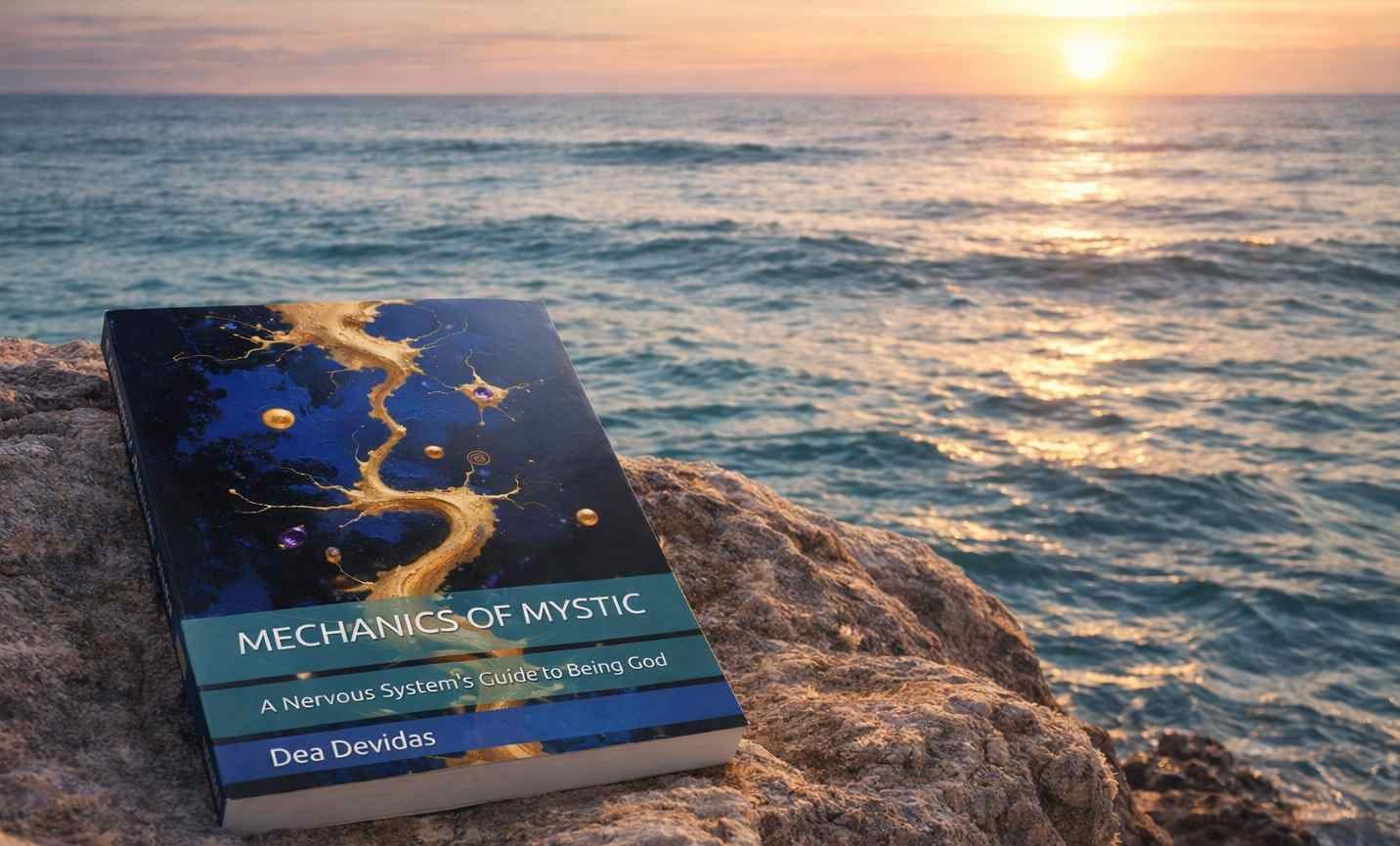
Mechanics of Mystic: A Nervous System’s Guide to Being God is 600+ pages of everything the spiritual industry sold you... dismantled. And then rebuilt with actual mechanics.
This is where grooves come from. Where fractals live. Where your nervous system learned to run the same episode on repeat and call it “karma.” Where manifestation stops being a vision board and starts being physics. Where trauma isn’t a wound but a filter. Where the Field isn’t a metaphor but the actual operating system of reality.
Your bones already know this book exists. Your blood has been waiting for someone to stop selling you the labyrinth and finally show you the exit.
Noo past lives. No angel guides. No cosmic complaints department. Just the mechanics. And how to work with them.
For everyone with thin skin and a thick bullshit detector.