

I’ve spent my entire life hunting for the quick fix. Not because I’m lazy (okay, partly because I’m lazy), but because I genuinely believe that if something works, it shouldn’t require a PhD, a meditation retreat, and three years of unpacking your relationship with your mother. It should work NOW. While the thing is happening. While your kid is melting down in the grocery store, while your partner just said THAT thing, while your bank account is giving you chest pain at 3am.
Your body doesn’t have time for theory. It’s drowning NOW. It needs a rope, not a lecture on the history of rope-making.
And then, somewhere in my shiatsu training, I discovered actual magic.
Not crystals-and-incense magic. Not “visualize your highest self” magic. The real kind. The kind where you’re drowning in grief that feels like it will never end, like you’ve always been sad and will always be sad and sadness is just your permanent address now... and then you press two points on your hand. Lung and large intestine meridian. Thirty seconds. Maybe sixty.
And the grief just... stops. Not suppressed. Not spiritually bypassed. Not “I’ll deal with this later.” GONE. Moved. Transmuted. Your neurochemistry shifted because you pressed your thumb into a specific spot on your flesh. That’s not woo-woo. That’s not placebo. That’s your nervous system responding to input that your ancestors knew about before we decided that only things in peer-reviewed journals count as real.
I remember sitting there, tear-streaked and bewildered, thinking: why did nobody tell me I had a reset button? Why did I spend decades believing I was at the mercy of my emotions when my own hands could change the channel?
This is what I mean by magic: the ability to change your state of consciousness at will.
Not waiting for the feeling to pass. Not journaling about it for six months. Not understanding WHY you feel this way before you’re allowed to feel differently. Just... changing it. Because you can. Because your body is wired for it. Because the technology is literally at your fingertips and nobody gave you the manual.
Until now.
Here’s the part I don’t usually admit out loud: I wrote this book because I want a happy world.
I know. I KNOW. It sounds like a Miss Universe answer right after “world peace” and right before the ugly crying. But I mean it.
I’m one of those people who feels everything. The room, the city, the collective weight of unprocessed grief scrolling through strangers’ nervous systems on public transport.
When the world is dysregulated, I feel it in my teeth. When people around me are spinning in chaos, my body picks it up like some kind of emotional weather system I never learned to turn off. I used to think this was a curse. Something broken in me. Too thin-skinned for this world.
But here’s what I’ve learned: sensitivity isn’t a flaw to fix. It’s data. And that data has been screaming the same thing for years.
We’re not meant to live like this. Constantly braced. Perpetually activated. Scrolling through emergencies we can’t solve while our own bodies beg for attention.
Imagine this for a second. You’re walking down the street. Your eyes meet a stranger’s. And instead of that weird split-second calculation we all do now... is this person a threat, are they going to ask me for money, are they judging my outfit, should I look away first... instead of ALL that, you just smile. They smile back. Two nervous systems passing each other and going “hey, we’re okay.” No agenda. No defense. Just two animals acknowledging each other’s existence and finding it... fine. Pleasant, even. Wouldn't it be lovely?
Or you’re sitting in a café. The person at the next table is having a hard day, you can tell. But their hard day doesn’t climb into your chest and set up camp. You notice it. You feel compassion. And then it passes through you like weather instead of moving in like a tenant who doesn’t pay rent. A world where strangers’ auras don’t feel like crime scenes. Where sensitivity is a gift you can actually enjoy instead of a burden you manage.
That’s what I want. Not because I’m noble. Because I’m tired. Because I want to exist in a society that isn’t optimized for keeping everyone’s cortisol at “constant low-grade emergency” so they buy more things and click more ads.
The clickbait collapses because nobody clicks. The outrage cycles fail because nobody needs the spike. The politicians who run on fear lose their audience. The industries that profit from your inadequacy go bankrupt. That’s not utopia. That’s just math. Change what bodies do and you change what economies do.
And here’s the thing that still blows my mind: it spreads. Not through convincing. Not through preaching. Not through posting infographics about nervous system health while your friends slowly mute you on all platforms.
It spreads through contact. Through proximity. Through what happens in the space between your body and the bodies around you.
When you’re regulated, the people near you have a regulated nervous system to borrow from. Your kid’s cells learn something they could never learn from your words. Your partner’s body starts to settle without knowing why. The room changes. Your calm is literally, measurably, contagious in ways that can be tracked on an EKG.
You don’t have to save the world. I’m not asking you to become a regulation evangelist, posting infographics about vagal tone while your friends slowly mute you on all platforms.
Your calm is literally, measurably, contagious in ways that can be tracked on an EKG. Your regulated nervous system becomes something the people around you can borrow. Your child’s cells learn something they could never learn from your words.
The revolution doesn’t need a flag. It just needs bodies that know how to stay.
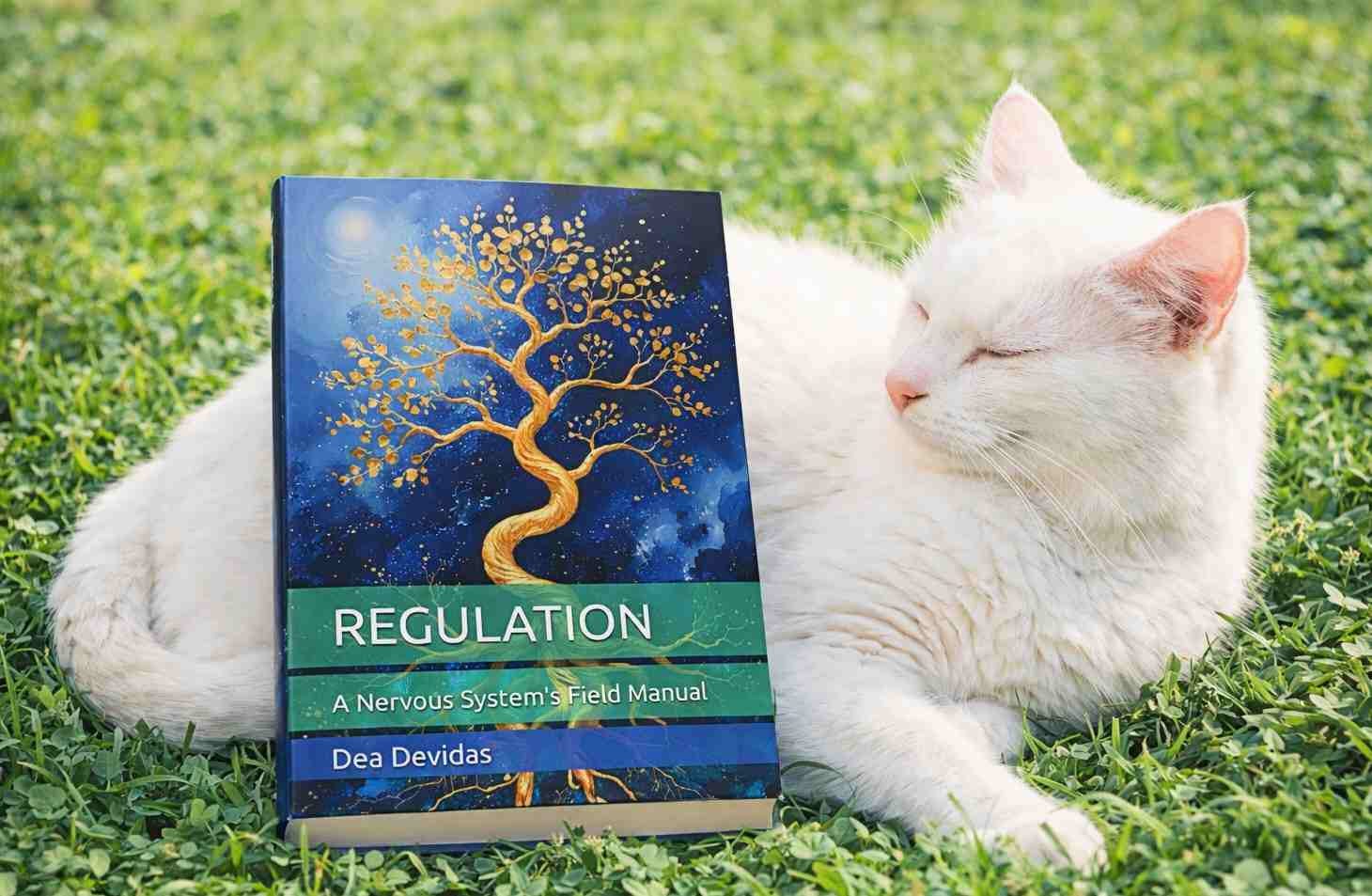
This book is the manual I wish someone had thrown at my head twenty years ago. Every chapter designed to be used WHILE the thing is happening. Not theorized about. Not saved for later. Not requiring you to be in the right mindset first.
You’re dysregulated? Good. Open the book. Do the thing. Feel different. That’s the whole system. Your body already knows how to regulate. It’s been waiting for you to stop Googling “how to relax” and start actually pressing the buttons.
The buttons are in this book. You’re welcome. ✨
Thank you for sharing this. Great title.
Thank you!