
Clean Dirt: Why You Won't Plant What You Actually Want (And What Happens When You Finally Do)
Your terrain is clear. Your hands are empty. Your excuses have expired. And your survival brain just filed a restraining order against commitment.

You’ve done the clearing. You’ve done the inventory. You’ve Marie Kondo’d your emotional life so thoroughly that your inner landscape looks like a Scandinavian apartment: beautiful, minimal, and vaguely unsettling because where did everything GO and why does the emptiness feel louder than the clutter ever did?
You’ve pulled the weeds. Named the patterns. Burned the dead wood. Journaled about it. Cried about it. Told your therapist about it. Told your best friend about it. Told a stranger at a dinner party about it because she asked “how are you” and your signal processor said “fine” but your limbic system launched a 40-minute TED talk on generational trauma with a live Q&A and supplementary materials.
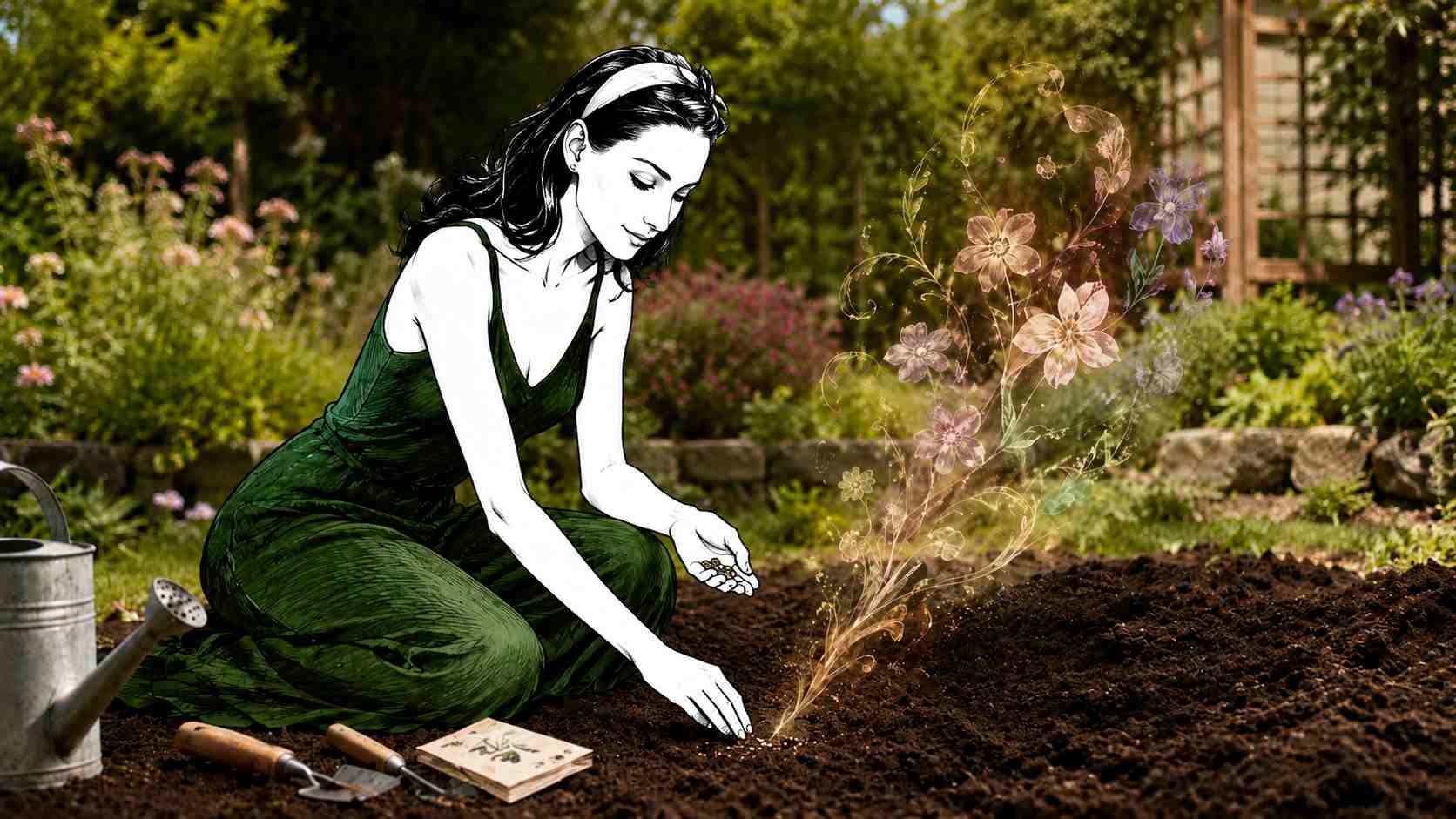
And now the field is clear. And now you’re standing at the edge of clean dirt with seeds in your pocket and you’re doing the one thing nobody warned you about.
You’re stalling. Because clearing can become an identity. It feels noble to be in the season of release. It gives your pain a job title. You are “in process.” You are “doing the work.” You are “letting go.” Everyone applauds this because release is dramatic and socially acceptable and looks excellent in a caption.
But planting? Planting has no aesthetic. Planting is awkward. It is specific. It is embarrassingly alive. It says: “I want this one thing enough to put it in the ground and be seen wanting it.” And that is where your survival brain starts coughing theatrically into a napkin.
Your hands know the shape of what they want to plant. They’ve known since before your first memory. Your palms hold the blueprint the way soil holds rain: without thinking, without deciding, without negotiating. This knowing lives below your name. Below your story. Below every version of yourself you’ve rehearsed for safety. It lives in the meat of your hands and the marrow of your wrists and it has been waiting with the patience of something that has nowhere else to be.
Here’s what nobody tells you about personal development. You can read every book. Do every course. Understand the pattern intellectually with such crystalline clarity that you could give a TED talk on it while simultaneously living out the exact pattern you’re describing, and your body would still do the old thing. Because the body doesn’t run on insight. The body runs on evidence. And the only evidence it accepts is: hands in dirt.
The Clean Field Has No Alibis
Clutter is generous. It gives you excuses. “I can’t plant yet, there are weeds.” “I can’t choose yet, the soil is full of old roots.” “I can’t begin yet, I am still clearing.” Beautiful. Very reasonable. Very Pinterest nervous breakdown.
But clean dirt is rude. Clean dirt does not negotiate. Clean dirt just sits there, open and silent, saying: “Now what?”
(Your amygdala, surveying the empty terrain: “What the FUCK is this. Where’s the chaos. Where’s the crisis. I had a SYSTEM. I had my scanning routes memorized. I knew which weeds to check at 3am and which dead branches to obsess over at 11pm and now it’s just... DIRT. Open dirt. With NOTHING to monitor. Do you understand how unsettling this is for a highly trained surveillance professional? I am going to create a small crisis just to feel useful. Where did I put those intrusive thoughts about whether your entire career is just a prolonged episode of impostor syndrome? Those always play well at 2am. I’m going to run a double feature tonight. You’re welcome.”)
That question, “now what,” is violent in its simplicity. Because once the field is clear, the issue is no longer what blocked you. The issue is what you are willing to claim. And claiming is harder than clearing because claiming leaves evidence. Clearing is private. You can clear in your journal, your therapist’s office, your shower at 11pm. But claiming? Claiming puts your fingerprints on something. Claiming says “this is mine” in a voice your body can hear. And your body has a very specific memory of what happened last time something was yours.
Why Clean Dirt Is Terrifying (A Neurological Field Guide)
Here’s what’s actually happening in your body when you stand in front of cleared terrain and freeze. Your threat detection system (amygdala, brainstem, the ancient committee that was fully operational before you could walk) has one primary function: scan for significance. Not just danger. SIGNIFICANCE. It asks: “Is this new? Important? Emotionally loaded? Potentially unsafe?” And when your system has spent decades learning that the unknown usually becomes pain, significance gets pre-labeled as threat.
Clean dirt is unknown. You’ve never been here before. The clutter was familiar. The weeds were YOURS. The dead wood had names and stories and you knew exactly which branch to lean on when you needed to feel something recognizable, even if recognizable meant painful, because painful-and-familiar is a cocktail your reward system learned to call “home” before you had any say in the matter.
Your body reads open space the way a child reads an empty house. Not as possibility. As evidence that something left. Your cells don’t distinguish between “cleared on purpose” and “abandoned.” Your fascia holds the shape of every room that emptied before you were ready. And this new space, this clean dirt, this beautiful brutal openness... your body’s first read is not “opportunity.” It is prediction from old data: open space means something is about to be taken.
Your body’s filing system has exactly two categories: “this happened before and it hurt” and “this hasn’t happened before which means it WILL hurt, we just don’t have the specifics yet.” There is no third folder. There is no folder called “this might be nice.” That folder was deleted in 2004 to make room for more storage in the “what could go wrong” department, which now occupies 94% of your emotional hard drive and has its own IT team.
This is predictive coding in the dirt. The body does not ask, “What is this field now?” It answers from old files: “Open space means something left. Wanting means danger. Planting means attachment. Attachment means future grief.”
New field. Old prediction. Clean dirt. Ancient alarm. The brain is not trying to sabotage your garden. It is trying to prevent a funeral it assumes is inevitable.
(Your signal processor, proudly presenting its latest analysis: “I’ve identified 846 sub-patterns within the main pattern, cross-referenced them with three attachment theories and two quantum field models, and created a color-coded matrix showing exactly why we’re not ready to plant anything until at least Q3 of... checks notes... never. The good news is: the analysis is BEAUTIFUL. I’ve used Pantone colors. The bad news is: the dirt is still empty and our hands are still clean and I’m starting to suspect that the analysis IS the avoidance but I can’t stop because stopping would mean FEELING something and that’s the limbic department’s jurisdiction and frankly their office is a mess.”)
Your throat holds two languages right now. One that says “I know what I want.” And one that was installed before you had syntax, that says wanting is where safety ends. Your neck is the bridge between those two languages and it is stiff because the traffic goes in both directions and nobody is yielding. Every swallowed desire sits in your fascia like a handwritten letter that never found a mailbox.
The Observer Effect of Desire
Here’s where it gets interesting. And by interesting I mean “your survival brain is about to have a full meltdown in a very well-lit room.”
The moment you admit what you want, you change the field.
Before the admission, desire can hide as mood, fantasy, vague longing, aesthetic preference, “someday,” “maybe,” “when I’m ready.” Before the admission, your wanting is a weather pattern with no mailing address. Gorgeous. Untraceable. Safe. Unspoken desire is the ultimate commitment-free relationship. You get all the feelings without any of the consequences. It’s like dating someone in your head: they never leave dirty dishes in the sink, they never forget your birthday, and they never ask you to actually show up with your whole body on a Wednesday. Imaginary futures are very low-maintenance partners. Real ones require you to exist.
But spoken desire is an observation. It collapses the blur. It turns the fog into a coordinate. “I want to write the book.” “I want the house.” “I want the partnership.” “I want the life where my hands are not always empty.”
The observer effect here has nothing to do with mystical surveillance by the universe. It’s simpler and more annoying: the moment you name what you want, your behavior changes around it. Attention becomes allocation. Allocation becomes evidence. Evidence becomes a path. And paths are visible.
Congratulations. Your desire has become locatable. Your survival brain hates this. It DEEPLY preferred when you were a beautiful weather pattern with no coordinates and no evidence and no path that anyone, including yourself, could follow back to the place where you admitted you wanted something with your WHOLE body.
(Your dopamine system, trying to redirect: “Hey! What if instead of naming the thing we just... PLAN? Planning is amazing. Planning feels like progress. Let me release just enough reward chemicals to keep you in the planning phase forever. You’ll feel productive! You’ll have seventeen Notion boards and zero actual seeds in actual dirt and you’ll be EXHAUSTED but in that comfortable ‘at least I’m doing something’ way that doesn’t require you to commit to anything that could actually grow into something you’d have to TEND on a boring Thursday when nobody is watching. Planning gives me a snack. Commitment gives the body a job. I prefer snacks. Please don’t make me work.”)
Planning is flirting with your future while refusing to give it your address.
Your belly holds the coordinates your mind keeps trying to erase. Your pelvis holds the weight of the want you keep calling “not yet.” And your wrists, the tender underside where pulse meets air, hold the readiness your signal processor keeps filing under “more research needed.” But your pulse doesn’t wait for research. Your pulse has been counting down to this your whole life. It just didn’t have permission to be loud until now.
The Five Firmware Programs That Keep Your Hands Out Of The Dirt
Program 1: “I’m Still Preparing”
This one is elegant. It masquerades as responsibility. Due diligence. Self-awareness. “I’m still healing.” “I’m still figuring it out.” “I need to be READY.”
You’ve been preparing for eight years. Your preparation has a preparation. Your healing journey has its own healing journey. You’ve done more inner work than most people do in three lifetimes and your signal processor has analyzed your patterns so thoroughly it could publish a peer-reviewed paper with citations and a supplementary data table and an appendix titled “Reasons I’m Not Ready: A Comprehensive Taxonomy, Volumes I through XIV.” Preparation can be sacred. Until it becomes dissociation with better stationery.
There is a kind of preparation that ripens the body for action. And there is a kind that keeps action safely theoretical. You know the difference by the body. Real preparation gives weight to the hands. Avoidant preparation keeps the hands clean.
Your bones don’t need more preparation. Your bones have been ready since before you started preparing. Your bones were ready the day you were born with fists clenched around something invisible that your hands have been trying to remember ever since. The body is not the assistant to the decision. The body is where the decision becomes real. And your body has been standing at the edge of this field with dirty-ready hands for longer than your analysis wants to admit.
“I’m preparing” is the most expensive sentence in the human language. It costs you one day at a time. And each day costs exactly what it always costs: the thing you would have planted if you’d stopped preparing.
Program 2: “What If I Choose Wrong?”
This is the quantum program. The superposition of possibilities. While you don’t choose, all options remain open. Thirty-seven versions of your life coexist peacefully in the probability cloud of “maybe.”
In quantum language, commitment is measurement. Not literally, because you are not a photon with childhood trauma, although honestly the resemblance is concerning. But as a metaphor, it’s precise: before action, your life can remain a private probability cloud. Elegant. Untouchable. Full of imaginary dignity. The moment you put the seed in the soil, the system is measured. The wave function collapses. The fantasy loses its infinite wardrobe and becomes one actual body standing in one actual garden with one actual responsibility.
This is why your system prefers potential. Potential cannot fail. Potential cannot disappoint. Potential cannot ask you to water it on a boring Thursday when nobody is watching and the glamour has completely evaporated and all that’s left is you and dirt and the quiet terrifying holiness of tending something real.
Potential is perfect because it is not real. Reality is rude because it needs maintenance.
Before you choose, all imagined lives remain emotionally available. They are not real, but they still feed the system with possibility. The moment you choose, those imagined lives lose their charge. Not because the universe murdered them (very rude), but because your attention, time, and body have entered one path. One seed receives water. The others remain perfect in imagination and unfed in reality.
(Your limbic system, mourning hypothetical futures: “Okay so we’re saying goodbye to the version where we moved to Portugal. And the one where we became a ceramicist. And the one where we stayed with that person who made us feel electric and terrible in equal measure. And the one where we just... kept drifting. Comfortably. With no roots and no fruit and no vulnerability and no garden and no dirt under our fingernails and no evidence that we were ever HERE, in this one specific life, choosing this one specific thing with these one specific hands. That version was so COMFORTABLE. Why are we killing it? Oh. Because comfortable and alive are different things. Right. Fuck.”)
Choosing wrong is a myth your firmware invented to keep you in the superposition. In reality, there is no wrong seed. There is only the seed you plant with your actual hands in your actual dirt on your actual Tuesday afternoon... and the thirty-seven seeds you hold in your imagination forever, where they stay perfect and hypothetical and completely, devastatingly, unfed.
Program 3: “Someone Will Take It”
Your threat detection system has a specific memory file labeled “things that were mine and then weren’t.” It opens this file every time something good tries to happen. Promotion? Opens file. Love? Opens file. Money in the bank? Opens file, cross-references with historical data, generates probability model of loss, floods system with anticipatory grief.
Anticipatory grief is the body mourning a loss that has not happened yet so it can pretend to be prepared when it does. Very efficient. Very miserable. Like crying at the funeral of a plant you have not watered because you were too busy imagining it dead.
Your threat detection system has basically become that friend who Googles symptoms at 2am and tells you you’re dying. Except the symptom is “I planted a tomato” and the diagnosis is “you will love this tomato and then a bird will eat it and you will feel a grief so specific it doesn’t have a German compound word yet, but it should, and it should be very long.”
This program says: “Don’t get attached. Don’t invest. Don’t put your hands in this dirt because the last time you loved something THIS much, it was removed, and the removal lived in your body as a frequency that you now mistake for intuition.”
Your chest carries the archive of every garden that was taken. Your lungs hold the exhalation of every space that filled and emptied. And your hands have developed an unconscious habit that deserves its own name: hovering. Not touching. Not holding. Not claiming. Hovering. Because hovering means you can withdraw quickly. Hovering means your fingerprints aren’t on anything that could be taken.
Hovering is a full body strategy. The mind gathers more information (feels productive). The reward system enjoys the feeling of almost-progress (feels safe). The threat system delays exposure (feels smart). The motor system stays uncommitted (feels free). The hands remain clean. Very organized. Very expensive. Congratulations, you built a greenhouse for imaginary plants. The deeper fear is not “what if it fails?” The deeper fear is: “what if it GROWS and then I have something to lose?”
(Your oxytocin system, trying to do its actual job: “Hi, yes, I’d like to help with the planting. I have the chemicals for bonding, attachment, and the warm feeling you get when you commit to something with your whole body. I’ve been ready for... checks timestamp... your entire life. The issue is that every time I try to release the shipment, the threat detection system intercepts it and replaces it with cortisol. It’s like having a care package rerouted to a military base. I have SO MUCH tenderness to deploy and zero security clearance to deploy it. Could someone please tell the amygdala that attachment to good things is not the same emergency as attachment to dangerous things? She’s using the same protocol for both and honestly it’s unprofessional.”)
Program 4: “I Don’t Deserve A Garden”
This one doesn’t announce itself. It doesn’t have a voice. It’s not a thought. It’s a DENSITY. A heaviness in your hands when you reach toward something good. A micro-flinch when someone says “this could be yours.” A slight turning away, almost imperceptible, so practiced it looks like preference when it’s actually the most sophisticated avoidance your body has ever engineered.
Shame does not always say “you are bad.” Sometimes shame says “do not reach.” It lowers the volume of desire until wanting feels inappropriate. It makes ownership feel arrogant. It makes receiving feel suspicious. It makes planting feel like taking something from someone, even when the dirt is yours, the seed is yours, and no one is standing there except your inherited guilt wearing a clipboard.
You don’t walk around saying “I am unworthy of a garden.” That would be too honest. Instead you say things like “I’m more of a low-maintenance plant person” and “I just haven’t found the right soil” and “honestly I think my lifestyle is more suited to succulents,” which is the botanical equivalent of “I’ve given up on being fully nourished but I’ve branded it as aesthetic minimalism.”
The deserving wound does not live only in language. It lives in reach. In grip. In the microsecond before your hand closes around what is being offered, and something fires in your brainstem that says “not for you” with such quiet authority that you believe it’s wisdom when it’s just old voltage running through a very old wire.
Your worth is not a thought you can think into existence. In the body, “frequency” means the repeated baseline state your system returns to most often: posture, breath, muscle tone, expectation, the micro-behaviors that run underneath every conscious decision. And right now, two frequencies are fighting for the same channel. The old one (”I earn my place by producing, performing, shrinking”) is losing signal. The new one (”I am here, that is enough, my hands can hold what they hold”) is coming in. Staticky. Intermittent. Sometimes loud enough to make you cry for no reason in the produce aisle. But coming in.
Program 5: “I’ll Start Tomorrow”
(Your entire system, running Program 5: “Okay so today is not ideal because we didn’t sleep well and the astrology is... actually the astrology is fine, shit, we can’t use that excuse. And the moon is... the moon is also fine. DAMN IT. Okay, today is not ideal because we’re not in the right headspace. Tomorrow. Tomorrow we’ll plant. Tomorrow the conditions will be... what. Better? They won’t be better. The dirt doesn’t get cleaner than this. The field doesn’t get more cleared. The seeds in our pocket don’t get more viable. But TOMORROW has a quality that today doesn’t: tomorrow doesn’t exist yet. And things that don’t exist yet can’t disappoint us. Tomorrow is the last superposition left. The final ‘maybe.’ If we plant TODAY, even tomorrow loses its shimmer. And then what? Then we’re HERE. In a garden. With dirt under our nails. VISIBLE. INVESTED. ALIVE. With fingerprints on something real. Fuck. That’s terrifying. Let’s reorganize the seed packets by color instead.”)
Tomorrow is the final hiding place of the uncollapsed self. It lets you keep the identity of someone who WILL begin without having to endure the vulnerability of someone who HAS begun. Tomorrow is clean. Today has fingerprints.
The Dirt Is Not Waiting for the Perfect You
The dirt does not need your confidence to be photogenic. The dirt does not need your trauma healed to museum quality. The dirt does not need your nervous system to be fully regulated, your chakras aligned, your attachment style secure, your inner child holding a diploma in emotional literacy, or your morning routine optimized by a Scandinavian productivity guru with perfect skin and a $46 gratitude app. The dirt only needs contact.
This is where the spiritual industrial complex gets deeply annoying. It sells you the fantasy that one day you will feel clear, calm, aligned, unafraid, properly hydrated, nervous-system-regulated, attachment-style-secure, inner-child-certified, morning-routine-optimized, breathwork-graduated, somatic-experiencing-completed, polyvagal-theory-fluent, and whatever the next $297 certification tells you is the prerequisite for being a person who does things. And THEN you will begin.
No.
You begin with a shaking hand. You begin with your threat detection system throwing furniture in the background. You begin with one seed, one breath, one ridiculous Tuesday where nothing is perfect except the fact that you stopped hovering.
The perfect self is another delay tactic. Your body does not need perfection to plant. Your body needs PERMISSION. And permission does not come from readiness. Permission comes from the moment your hands get tired of being empty and your survival brain runs out of arguments and your chest opens by a millimeter, which is the exact width of a seed entering soil, which is the exact width of a life beginning.
The brain does not need a bigger plan. It needs new evidence from the body: I can want, touch, plant, and remain safe enough to stay.
How To Put Your Hands In The Dirt
The body doesn’t plant through decision. The body plants through CONTACT. You can decide to plant for seventeen years and never touch the dirt. You can plan the garden, research the soil, buy the gloves, watch the YouTube tutorial, subscribe to the newsletter, and never once bend down. Planning gives the brain a reward preview without the exposure of reality. It activates anticipation, control, novelty, possibility. All the delicious chemicals of beginning, none of the terrible intimacy of continuing.
Planning is flirting with your future while refusing to give it your address.
A seed is not small. A seed is an attractor. The moment it enters the soil, the field has a center. Water has somewhere to go. Attention has somewhere to land. Time has something to shape. Before the seed, energy drifts. After the seed, energy orbits. That is why you fear planting. Not because the seed is fragile, but because the seed organizes you. You can drift with empty hands. You cannot drift while tending something alive.
Your skin is the border between intention and reality. Every commitment you’ve ever made that actually changed your life passed through your skin first. You signed the paper. You held the hand. You placed your foot on the ground of the place you decided to stay. Your skin is where “maybe” becomes “yes.” And your hands are the part of your skin that was designed for this particular yes. For pressing seed into soil with the specific pressure that says: I am not hovering anymore.
Here’s the practice.
First: bring the tongue softly to the roof of the mouth. Let the jaw unclench. Let the breath drop from the forehead into the belly. Place one palm briefly on the heart, one on the lower belly. Let the heart remember desire. Let the belly remember ground.
Now stand. Feet on the floor. Barefoot if you can. Feel the ground. Not the concept. The TEMPERATURE.
Put your hands in front of you, palms down. Hover them over a surface. A table. The floor. The dirt outside if you have it. HOVER. Feel the hovering. This is what you’ve been doing. This is the shape of almost. The architecture of not-quite.
(Your hands right now: “We’ve been hovering so long we qualify for frequent flyer miles. Can we PLEASE just land somewhere. Anywhere. Even economy class. We don’t need business. Just A SURFACE.”)
Now: lower your hands. Make contact. Press.
Feel the surface press back.
That pressing back is reality responding to desire. That resistance under your palms is the world saying: I can hold what you put here. Physical contact does not magically make the decision for you (thank God, otherwise tables would be life coaches). But touch gives the body something the analysis can’t: sensory evidence of ground, resistance, contact, HERE. It moves the choice out of abstract simulation and into the body, where the decision becomes real, where it always needed to be, where your hands tell the truth your analysis keeps postponing.
Stay there. Ten breaths. Feel your heartbeat in your palms. That pulse is the rhythm of someone who is HERE.
Now say one sentence. Out loud. The sentence that has been living below your sternum since the clearing ended and the clean dirt appeared and your hands have been hovering ever since.
“I plant ___.”
Not “I want to plant.” Not “I’m thinking about planting.” Not “Maybe I’ll plant.”
“I plant.”
If the sentence is too big, make it smaller until the body does not have to lie.
“I plant one page.” “I plant one conversation.” “I plant one application.” “I plant one honest yes.” “I plant one hour where I stop performing safety and practice being alive.”
(Your amygdala, hearing “I plant one page”: “One page? ONE page? That’s... actually, that doesn’t sound that threatening. I was preparing for ‘I’m restructuring my entire life by sunrise.’ One page I can... okay. Fine. ONE page. But I’m monitoring. And if that page turns into two pages I’m calling a meeting.”)
The system trusts specificity more than drama. One true seed, named and claimed, changes the field more than a hundred hypothetical gardens.
Release one soft “fff” through the mouth. Feel the exhale carry what the jaw has been holding.
Your body will know the moment the seed is real. Not because trumpets sound or the universe sends a sign or your chakras do a standing ovation. Because something in your chest LANDS. A weight that is not heaviness but GRAVITY. The kind that keeps planets in orbit and feet on ground and lives in bodies. The kind that says: this is mine. I chose this. And I am staying to see what grows.
Planting is the yes. Returning tomorrow to water is the devotion. You don’t have to become the whole garden today. Just stop pretending you don’t have the seed. 🔥✨💎
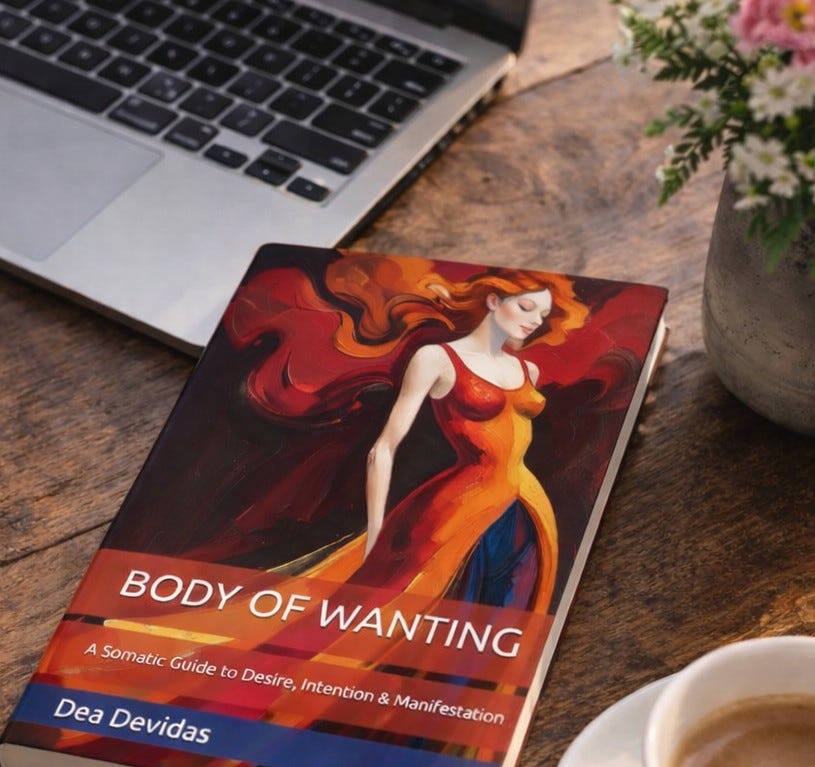
📖 More about wanting: Body of Wanting is the full somatic field guide to everything this essay touches.
Thank you for this today, I'm going to go write my pages!
The thing that jumped out and resonated like a loud temple gong -" Your cells don’t distinguish between “cleared on purpose” and “abandoned.”" Thankyou!